April 23, 2026
Boardroom Branding Journey
The Boardroom Branding Journey is a two-phase, five-step path from where most qualified executives stand today to where they need to be to consistently attract board opportunities. Phase one builds the positioning and the supporting assets. Phase two builds the authority and visibility that compound over time. Each step rests on the one before it. Skip a step and the whole thing wobbles. Done in order, the journey turns a hidden expert into a recognized candidate over a twelve- to twenty-four-month horizon.
Most board candidates approach the process as a series of disconnected tasks. Update the resume. Refresh the LinkedIn profile. Tell some people you're looking. The work that actually produces board seats is sequenced, cumulative, and runs on a timeline most executives underestimate. It's a journey, not a checklist.
The first board seat is usually the easiest one to explain.
Someone you know called. They knew you, they trusted you, they thought you'd be a good fit. The conversation moved quickly. The introductions were warm. The selection process felt almost informal compared to what you'd been led to expect.
The second board seat is where things change.
The network that produced the first one has already produced it. The deal flow you thought you had turns out to have been a moment in time rather than a pipeline. The phone calls slow down, then stop. You start hearing about appointments through industry news instead of through introductions. The people who would have called you a year ago haven't called you in six months.
This is where most candidates start asking what to do, and it's where most of them start doing the wrong things in the wrong order.
The Boardroom Branding Journey is the right order. It's not a quick fix, and it's not a content marketing campaign. It's a sequenced, two-phase progression that takes a qualified-but-invisible executive and turns them into a candidate who consistently shows up in the rooms where board appointments get made.
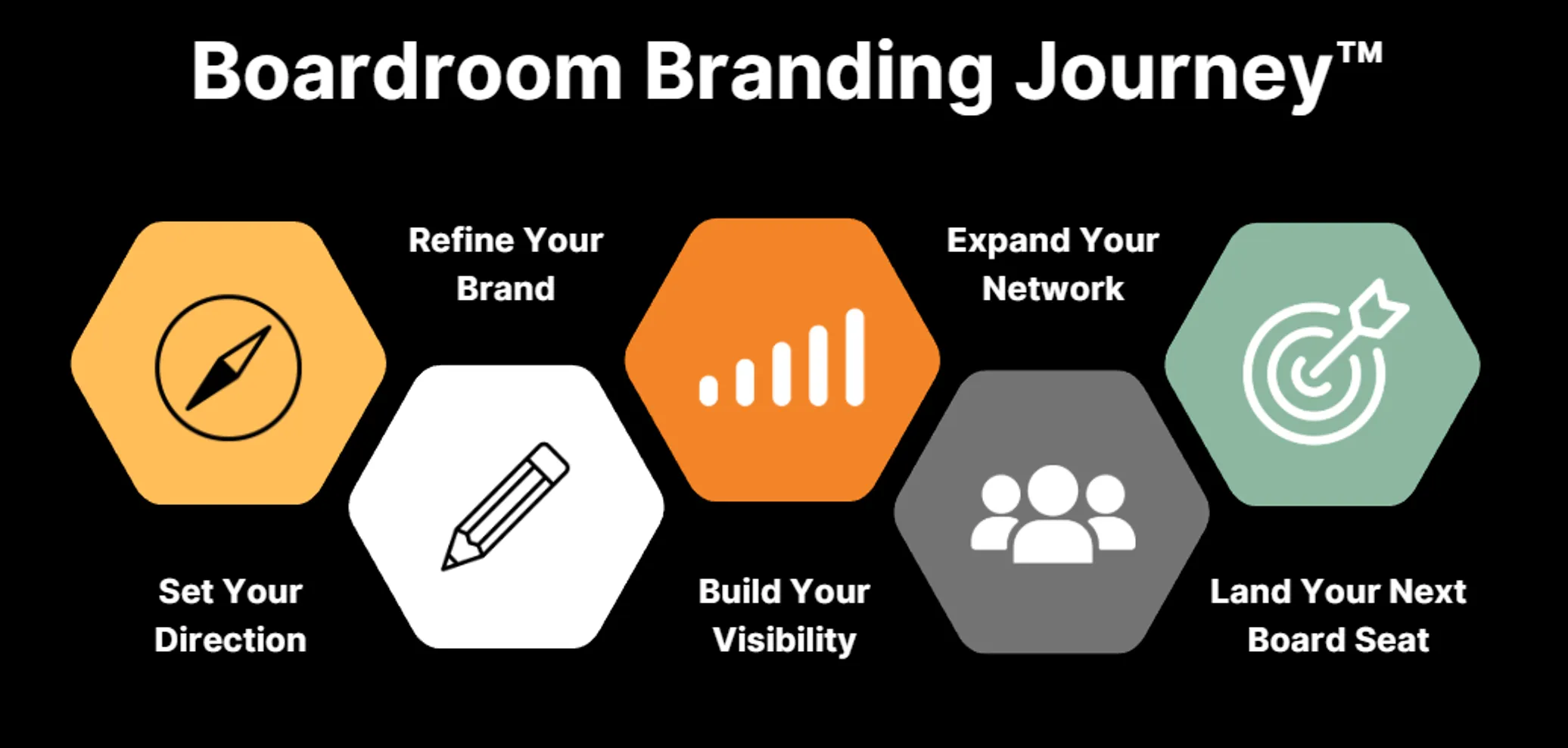
The journey has five steps across two phases, and each step rests on the one before it.
Why a journey, not a checklist
It's tempting to approach board positioning as a list of tasks. Update the resume. Refresh the LinkedIn profile. Get some recommendations. Tell people you're looking. Maybe write something occasionally.
The list approach fails for the same reason most career transitions fail when they're treated as tasks. The steps depend on each other in ways the list doesn't show. The resume can't be written well until the positioning is locked. The LinkedIn profile can't be optimized until the resume is settled. The thought leadership work doesn't compound until the positioning has been clear long enough to anchor a body of work. Skipping ahead, or doing the steps out of order, produces a brand that looks like it was assembled rather than built. Search committees can tell the difference, even when they can't articulate it.
A journey, by contrast, has direction, sequence, and cumulative weight. You're not finishing tasks. You're building something that's worth more at the end than the sum of its parts. The work compounds because each layer reinforces the ones beneath it.
Phase one: Board positioning
The first phase is about getting the foundation right. It's the work that has to happen before any of the visibility work will pay off. Most candidates want to skip it. The ones who don't are the ones who get the calls.
Step one: Boardroom Success Proposition
The first move is the smallest and the hardest. It's a single, tight statement that answers three questions. Who are you? What value do you bring? What kind of board are you looking for?
Done well, the proposition sounds easy to read and is genuinely hard to write. It forces you to pick. You can't be the West Coast CTO with deep SaaS scaling experience and a cybersecurity governance focus and also be the operations executive with regulated industry exposure and turnaround experience. Pick the one that maps to your actual Zero Competition Target, the overlap of your industry expertise, your functional expertise, the problems you're genuinely passionate about solving, and where the market need actually lives. That's the proposition.
The work of finding it takes longer than most candidates expect. It's also the highest-leverage work in the journey, because everything downstream depends on it. The resume, the bio, the LinkedIn profile, the cornerstone article, the framework, all of these get easier and sharper once the proposition is locked. They get harder and fuzzier when it isn't.
Step two: Board resume and board bio
With the proposition in place, the resume and bio become writing exercises rather than identity questions. You already know what story you're telling. The job is to tell it well.
The board resume is not a corporate resume with a new headline. A corporate resume is achievement-based and execution-focused. A board resume is strategic and governance-focused. It emphasizes oversight, influence, and the perspective you bring into the boardroom rather than the work you rolled up your sleeves to deliver. Two pages. Contact information, executive summary, board activity, executive experience, education and certifications. Clean design. No clip art globes. No charts and graphs. The success proposition does the heavy lifting at the top, and the rest of the document supports it.
The board bio is shorter, often three-quarters of a page, written in third person, and built so it can be dropped into a board package or a speaker introduction without further editing. It's a tool, not a creative exercise. Build it once, well, and it serves you for years.
These two assets are the table stakes of the journey. Without them, you can't move into the visibility phase, because there's nothing for the visibility to point at. With them, you have the documents that show up the moment someone asks for them, which is more often the determining factor than candidates realize.
Phase two: Authority building
The second phase is where most candidates either accelerate or quietly stall. The foundation is in place. The question becomes whether you'll actually do the work that turns the foundation into a brand the market can see.
Step three: Optimized online profiles
The third step is making yourself findable and credible to people who haven't met you yet. For most board candidates, this means LinkedIn, with a personal website as a useful supporting asset.
The goal isn't to become a LinkedIn influencer. The goal is to make sure that when a board recruiter, a non-gov committee member, or a peer who's about to recommend you clicks through to your profile, what they see matches the relevance, credibility, and visibility they're looking for. A complete profile. A headline that reflects your proposition rather than your last corporate title. A summary that gets the value across above the fold. A professional photo. Built-out experience entries that emphasize governance and strategic contribution. Recommendations from people who've actually worked with you.
The number of followers is not the metric. What matters is whether the people who do see your profile recognize you as an authority in your area. Ten thousand random connections is worth less than two hundred people who would pick up the phone.
A personal website becomes useful when there's friction in the search results, when someone else shares your name and shows up unfavorably, or when you want to host your bio, articles, and contact information in a place you control. It's not required, but it expands the surface area of your visibility and signals seriousness in a way LinkedIn alone doesn't.
Step four: Thought leadership and signature frameworks
The fourth step is the one that compounds the fastest and the one most candidates never reach.
Thought leadership at this level means sharing original, valuable ideas that move your industry forward. It means having a point of view on the questions your industry's CEOs are wrestling with, framed clearly, published consistently, and supported by the experience that earned you the right to hold it.
The unlock at this step is the signature framework. Something memorable, simple enough to sketch on a napkin, that captures your perspective on a meaningful industry problem. The IP3 talent model. The Ground Truth framework for property investing. The Fiduciary Resilience model for boardroom oversight of technology risk. Each one anchors a body of content, gives the candidate something to be known for, and shows up in the AI search results when someone asks about that topic. The framework isn't a marketing gimmick. It's a piece of intellectual property you build once and that does the work of representing you for years.
Around the framework, you build a cornerstone article that lays out your full perspective and a modest, sustainable flow of supporting content that returns to the same problem from different angles. The cadence doesn't need to be aggressive. Once a week is plenty. What matters is the persistence and the coherence over twelve to twenty-four months.
This is also the step where the compounding becomes visible. The cornerstone article you publish in month two is still working for you in month twenty. The framework you build becomes shorthand that other people start using to describe what you do, which is the most efficient form of word-of-mouth visibility there is. The AI systems that increasingly pre-filter longlists for board recruiters start surfacing your name on the questions you've made your own.
Step five: Network expansion and engagement
The fifth step is what most candidates do first, and it's what works least well when it's done first.
Network expansion, done at the right point in the journey, is genuinely powerful. You engage with existing board directors and search firms. You participate in industry associations and share your expertise. You stay active in the governance communities like NACD and Direct Women. You communicate your interest in board service clearly and concisely, using the success proposition you spent the time to build. You ask for warm introductions. You offer connections in return, because nothing builds reciprocity faster than being useful to other people's searches before you ask them to help with yours.
Done at the right point, this work amplifies everything else. The recruiter who finds your LinkedIn profile and clicks through finds a tight proposition, a strong resume, a built-out profile, and a body of published work that demonstrates how you think. The peer who's about to recommend you actually has language for what to say. The board chair who hears your name remembers something specific.
Done at the wrong point, before the foundation is built, it produces awkward conversations and lukewarm introductions. The recruiter clicks through and finds a profile that doesn't match the conversation. The peer can't quite remember what to say. The board chair hears the name and can't place what you're known for. The network is willing. The brand isn't ready.
This is why the network step comes last in the journey, even though it's the most natural one to start with. The network does its best work when there's something for it to point at.
The timeline
Done in order, the journey usually plays out on a twelve- to twenty-four-month horizon, with the visible returns concentrating in the back half.
The first ninety days are mostly phase one. Lock the proposition. Build the resume and bio. Optimize the LinkedIn profile. By the end of this window, the foundation is in place. The brand is coherent. The assets are ready.
The next ninety days are the start of phase two. The thought leadership work begins. The framework gets built. The cornerstone article goes up. The supporting content starts flowing. The visibility work doesn't pay off yet in any measurable way, and that's the expected outcome at this point. You're not building a campaign. You're building an asset.
Months seven through twelve are where the asset starts doing work. The body of content begins to compound. The framework starts to get cited. The recruiter searches that surface you become more frequent. The peer-to-peer introductions start happening with better framing because the network finally has language for what you do.
Months thirteen through twenty-four are where the calls actually come. Not all of them. Not on a predictable schedule. But the pattern shifts. You stop being the candidate who has to chase opportunities and start being the candidate who has them surface in ways you didn't initiate.
This timeline is what most candidates underestimate, and it's what causes most of them to quit. The work in months one through six produces almost no visible return, and the temptation to abandon it is real. The candidates who keep going are the ones who've made peace with the timeline up front and decided to operate on it rather than on the one their instincts would prefer.
What the journey gets you
The end state isn't fame. It isn't even high visibility, in the conventional sense.
The end state is legibility. The right people, on the right questions, in the right rooms, can find you. They have language for what you do. They have something specific to remember when your name comes up. They have a clear reason to recommend you when a search lands that fits your profile. The AI systems that increasingly do the first-pass filtering have enough signal to include you in the longlist. The recruiter databases that maintain twelve- to thirty-six-month working lists have you on theirs.
That's the journey. Five steps, two phases, twelve to twenty-four months of compounding effort. The end of it is the position most qualified executives spend their careers wishing they were in and almost never reach, not because they aren't qualified, but because they never built the brand the qualifications deserved.
It's not all about who you know. It's about who knows you. The journey is how that second sentence becomes true.
About the author

David Kochanek
Founder
I help executives and companies build authority, visibility, and trust with thought leadership marketing and executive branding.